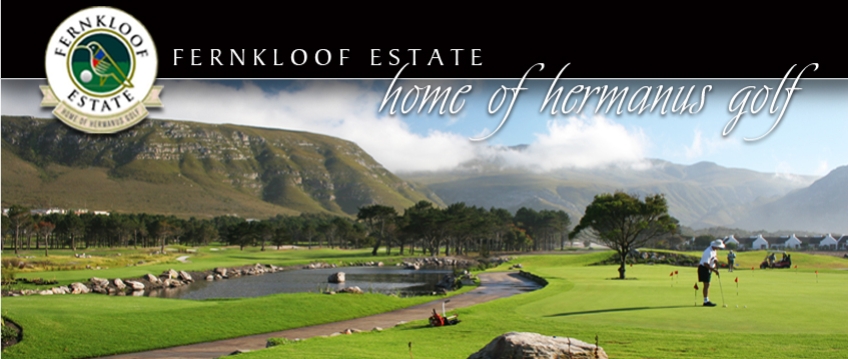
The Hermanus Golf Club has become one of the most popular golf courses in the country - a definite 'must play' course. It is also one of the oldest established courses, with a fascinating history dating back to the early 1900s.
On 29 November 1907 a meeting was held at Hermanus by ten residents of the village to form “The Hermanus Golf Club” and the terms of subscription should be 5/- (five shillings) per annum! So the club was started with the enterprise of ten enthusiastic golfers whose names are linked with the history of the lovely town of Hermanus.
Early club records reveal that the “artificial” greens were top-dressed with seashells, bought at one shilling and sixpence a load – surely a unique method of green keeping in South Africa. These greens were enclosed with poles and wire fencing to keep out the donkeys, sheep and cattle that grazed according to laws governing commonage. Local club rule number 3 in 1945 read as follows: ‘a ball lying, on the fairway in any wheel rut, mole cast or mole run, fresh or unspread dung etc. may be lifted and dropped without penalty.’
On 27 January 1923 a new club house were officially opened by His Royal Highness, the Governor General, Prince Arthur of Connaught. The course was extended to 18 holes in 1937 and remodeled and modernised again in 1952 by Grimsdell, the well-known golf course architect.
Over the years many notable golfers including the late Bobby Locke, Peter Thompson, Sam Snead, Dai Rees, Ken Bousfield, Bernard Hunt and Bobby Cole and many eminent personalities, and thousands of visiting golfers, have been attracted to this golfing mecca.
The club has been the venue for several top golf tournaments and exhibitions including the National Inter Provincial Match Play Tournament, the SA Country Districts Tournament, the Boland Open and the Hermanus Open tournaments for many years, and the present popular annual Walker Bay and Whale Festival Classic.
In 2006 the start of the latest remodelling began and by 2007 the course was extended by the addition of another nine holes by master designer Peter Matkovich of Matkovich and Hayes. This will establish Hermanus as a 27-hole championship course, further adding to the prestige and reputation of this much-loved institution.
The Hermanus Golf Club is a private course, offering privacy to the members, yet accessibility to the public.
|